WTJU Jazz Directorship: From one David to Another!
By WTJU
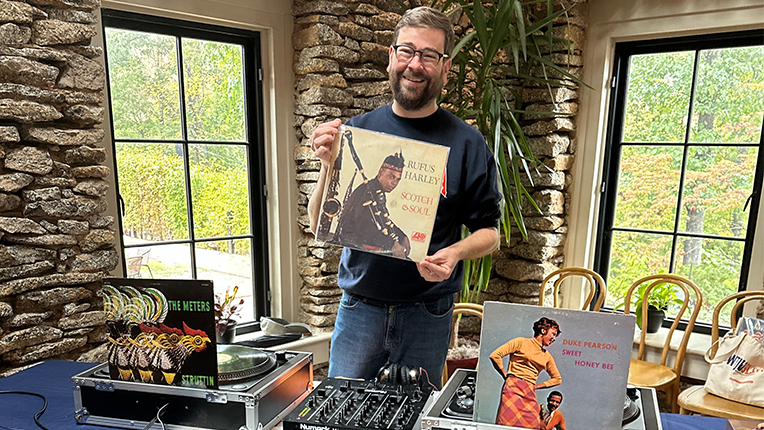
After three decades of WTJU Jazz directorship, David Eisenman is passing the mantle to David Buie-Moltz, WTJU DJ for 22 years, and current co-host of Second Sight (Mondays, 7 – 9 p.m.)! We welcome David Buie-Moltz in his new role! David is also the Director of Advancement Communications at UVA Darden School of Business, where he is engaged in a great deal of writing, with occasional negotiations over a comma. Enjoy a Q&A with him below.
How long have you been a host at WTJU?
I first went on the air in August 2004, starting in the rock department as a First Year undergraduate at UVA. I’ve been part of the jazz department since 2015. Somehow, that first date is now more than 22 years ago. I’m still processing that.
WHAT LED YOU TO WTJU?
My love of radio is my father’s. He raised my brother and me on The Big Broadcast, WAMU’s old-time radio program out of Washington, D.C. He recorded it onto cassette tapes on Sunday evenings, and we listened on the way to school in the mornings throughout the week. So I’m at least a second-generation radiophile.
I was also a music junkie, and as a high schooler in Culpeper, where I grew up, I could pick up WTJU at the edge of its broadcast range. By the time I got to UVA, I knew I wanted to spin records and be a DJ. That was where the cool kids were.
I made a beeline for the student activities fair, found the rock directors and immediately signed up to host. The cool-kid screening process was evidently quite forgiving.
HAVE YOU HOSTED SHOWS OTHER THAN YOUR CURRENT ONE?
Yes! During my first two years at UVA, I hosted The Evolving Definition of Indie Rock and Radio, Radio, both in the wee hours of Sunday morning.
In my Third and Fourth Years, I hosted Sans Serif, first alternating weeks with a partner and then solo for more than a year. It was a dream slot: Fridays at noon, after Brian Keena’s The Jazz Messenger and before Goldfinger’s Reggae Vibrations. Excellent neighbors for an undergraduate. Some of my happiest UVA memories.
When I returned to Charlottesville years after graduation, I co-hosted Point of Departure with my dear friend Freddie Jin, exploring avant-garde, free and spiritual jazz. That was my official transition from the rock department to jazz.
WHY SHOULD SOMEONE TUNE INTO YOUR SHOW IN PARTICULAR?
I’m after that “You have to hear this” feeling. Jazz and the music in its orbit cover far more ground than the label suggests.
I also love the art of the left turn, a habit from my rock DJ days. Saxophones, then synthesizers. Hard bop, then drum and bass. There’s a lot of “yes, and” in how I listen, and I love finding those connections. Ideally, you’re surprised without wondering whether you’ve accidentally changed stations.
The name Second Sight nods to sight-reading and sight-singing: encountering unfamiliar music and finding your way through it as you go. I’m still getting to know a lot of this music myself. Having a microphone hasn’t put an end to that. There’s something honest and exciting about exploring it together. Let’s listen.
EARLY MEMORIES OF MUSIC MAKING AN IMPRESSION ON YOUR LIFE
Not early in my life, but very early in my son’s. Before he was born, I put headphones on my wife’s belly and played him John Martyn’s “Head and Heart.” I was happy to try the Baby Mozart approach, with some latitude on the Mozart.
Now whenever I hear John Martyn, I think of that moment and my son. It happened again recently while I was spinning records at a WTJU vinyl event. Whatever it did for him, it certainly left an impression on me.
ROLE MUSIC HAS PLAYED IN YOUR LIFE?
It’s everything. So much of what I share with my father and brother comes back to music, and so many of my best memories live there.
I’ve forgotten a perfectly respectable amount of what I learned in school, but I remember high school band in vivid detail. Whole stretches of college are hazy, but my student DJ days at WTJU feel like yesterday. Those experiences stayed with me.
Now my wife, son and I make up songs around the house about the weather, our cat or whatever else happens to need a soundtrack. Music is the hub. The rest of my life connects to it.
FAVORITE MOMENTS IN THE AIR STUDIO?
Interviewing trumpeter and composer Wadada Leo Smith with Freddie Jin, my former co-host on Point of Departure. Here was a modern lion of avant-garde jazz in our humble studio, and we got to bond over a shared love of sound and exploration.
It felt like a culmination of what we’d been trying to do on the show: give that adventurous side of jazz a wider hearing and invite more people into the conversation. I’m still a little amazed this is something I get to do.
IF YOU COULD INTERVIEW ANYONE ON AIR, DEAD OR ALIVE, WHO WOULD IT BE?
Tom Waits. I think he’d feel right at home at WTJU. His music inhabits that wonderfully unclassifiable soup where I’ve always felt our jazz programming does some of its best work.
The challenge would be conducting a thoughtful interview while resisting the urge to spend the entire hour saying, “I really, really like your records.”
WHAT ARE YOUR PASSIONS OUTSIDE OF MUSIC?
UVA sports, Formula 1 and making coffee with an arguably unnecessary level of precision. Coffee is the one where I have some influence over the result.
WHY DOES WTJU MATTER?
Sharing music is an act of love. Here’s something that moves me, and I want you to hear it, too. When someone else feels it, there’s a bond. You have something in common, even if you’ve never met. There’s love in that recognition, too.
Connection can feel hard to come by right now. WTJU gives people a way to find one another through something they love. Over time, that becomes a community, a place where people feel they belong.
The world needs what WTJU offers. Helping people feel connected and a little less alone is a powerful thing. In some ways, it’s the most important thing we do.
HOW HAVE YOU SEEN WTJU CHANGE IN YOUR TIME HERE?
I’ve watched WTJU build on the generous spirit that drew me here. Moving from Lambeth, among the dorms, to Ivy Road gave it a more visible front door. Podcasts, new ways to listen and more opportunities to get involved have opened it wider still.
Nathan Moore has been a driving force in that growth, working with a remarkable group of staff, volunteers and supporters. It’s community service and community organizing in the guise of your friendly neighborhood freeform radio station. Ingenious, really.
The live music is a wonderful example. From Lambeth Live in the old space to Offbeat Roadhouse and Third Rail, the performances we bring to the air are exceptional. Peter Jones’s persistence in booking musicians keeps inspiring the rest of us to step up, and Lewis Reining’s technical ingenuity is a wonder to behold. They’re two examples of the many people whose care and hard work make this possible. You can hear it.
AS JAZZ DIRECTOR, WHAT DO YOU HOPE TO BRING TO AND/OR RECEIVE FROM THE EXPERIENCE?
I want to find more ways to connect the community we already have here and welcome new voices to the air. I suspect some of our next great programmers are just an invitation away.
I’m also mindful of the DJs who made WTJU what it is, including Professor Bebop and others we’ve lost recently. Building on their generosity means helping our programmers make the shows they’re excited to make and helping more people find their way into jazz and other music shaped by improvisation. There’s room for deep knowledge and for the person who just heard something they liked and wants to know what it was.
It’s strange and lovely to have arrived as a student and now be one of the people who can begin a sentence with “When I started here…” I intend to use that privilege sparingly.
I also expect to learn a great deal. The department has people with extraordinary knowledge and very different ears. Getting to spend more time with them is a substantial perk. I’ll try to make myself useful in return.
ANYTHING ELSE YOU’D LIKE TO SAY?
I want to thank David Eisenman for his 30 years of service to WTJU and his leadership of the jazz department. He has always been kind to me, going back to my student days, and his passion for this station and this music is unmatched. I’m grateful to have learned from him.
He signs his emails “Red beans and ricely.” I’ll do my best to live up to that spice.